SpaceX shares have fallen sharply from their early peak after a historic stock-market debut, as investors reassess the company’s current business and its ambitious artificial-intelligence strategy.
The company priced its initial public offering at $135 a share on 12 June. Trading opened at $150, climbed as high as $176 on the first day and closed at $160.95, making it the largest IPO on record, according to BBC reporting.
Shares later reached an intraday peak of $225 amid enthusiasm surrounding Elon Musk and SpaceX’s acquisition of the AI company formerly known as xAI. But the stock weakened as attention returned to SpaceX’s core rocket-launch and Starlink satellite businesses.
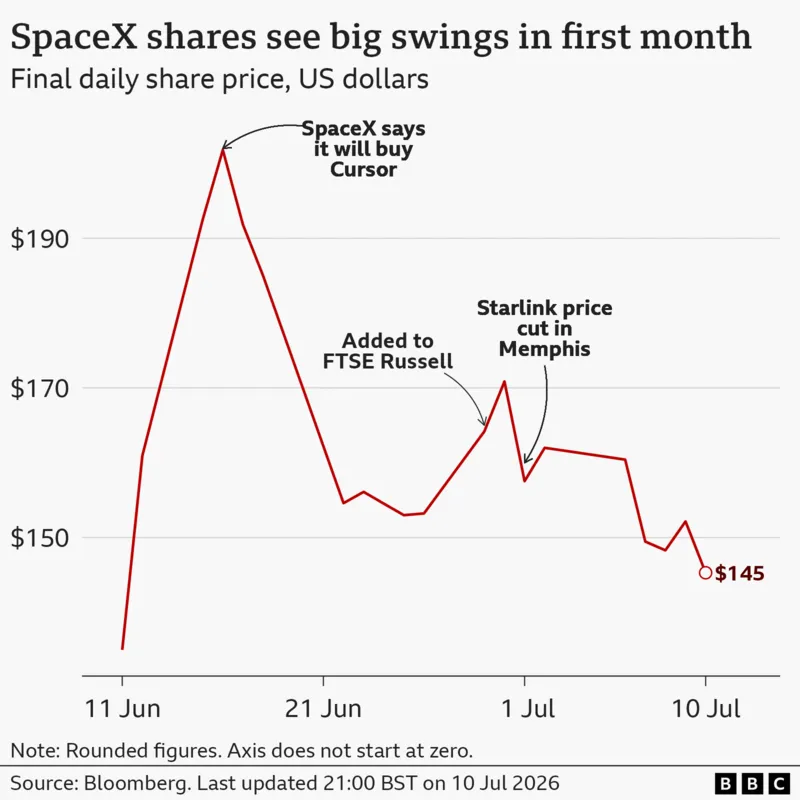
At the end of its first month, the stock traded around $145—about 35% below its peak and roughly 18% below the highest level reached on its first trading day. Investors who bought during the opening surge were therefore facing potential losses.
SpaceX’s addition to major indexes produced mixed results. Inclusion in the FTSE Russell index briefly supported the stock, while shares fell 4.4% on the day the company joined the Nasdaq-100, compared with a 1.7% decline for the index.
The company reported $18 billion in revenue last year and remains unprofitable. Musk has projected annual revenue of $1 trillion by 2030, while analysts are waiting for SpaceX’s first public earnings report, expected in early August.
Source: BBC News and Bloomberg market data. This report describes market conditions as of 10 July 2026 and is not investment advice.